
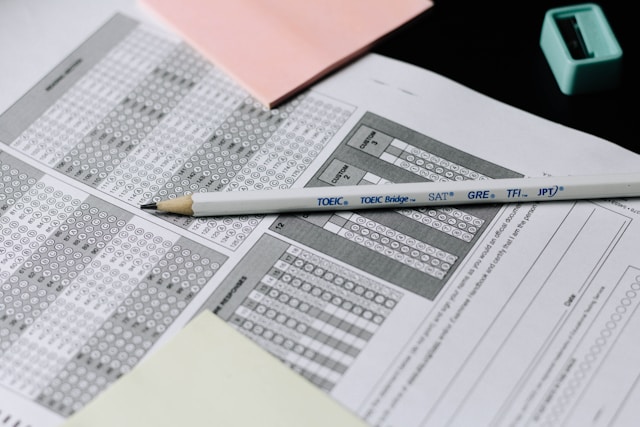
I was recently approached for tips to help with test anxiety and, after sending them, realized this could be helpful to others searching online for the same support. Here’s what I had to say:
Anxiety is our body and brain’s way of telling us something feels like a threat to our wellbeing. Our bodies release cortisol, a stress hormone, to get our bodies ready to face this threat. Our brains, while smart, can also be very silly: it doesn’t know the difference between cortisol because of a paper test, or stress from a tiger chasing us while dual-wielding knives. Cortisol is cortisol!
If you experience a lot of test anxiety, your body is preparing you to fight a tough challenge! It’s just, unfortunately, not the kind of challenge your brain is anticipating. You might feel panicked, blank out on information you know, or quadruple guess an answer you need to move on from.
If this is your experience, some of the best tips you can try are physical grounding techniques: your brain is preparing the rest of your body for a physical ordeal, so you can use physical cues to show your brain that you are safe to sit, think, and process information.
- Yawn or sigh! By exhaling longer than you inhale, you signal to your brain that danger is over. You don’t sigh while running from the tiger: you sigh when it’s over. You can also try inhaling to the count of 4 and exhaling to 6. Repeat this at least two more times.
- Relax the muscles in your body. All the tension tells your brain you are in danger. Do your best to notice that tension, and try to let it drain away.
- Focus on the feeling of your feet on the ground, your bottom and back in the chair. Bringing your awareness back to your body in the present helps your body know that nothing dangerous is happening right now. If you need an even smaller point of focus, try rubbing your fingers together and focusing on the feeling of your finger prints against each other.
It’s best to practice these physical tricks a few times in advance so you’re ready when you need them.
As for test-taking tips, I have always been good with tests! Here is what I’ve figured out:
- Go through the test on multiple passes. The first pass through, answer all the ones you know immediately and move on. For the questions you’re pretty sure about but want to review, put the answer you think it is but mark it to come back later. Skip and mark anything you’re puzzled about on the first pass. Once you get to the end of this first pass, go back and work on those tough ones. Save the ones you have an answer but want to review for last. This way you’ve at least answered everything and won’t miss points because you never saw some of the questions.
- If you are pretty sure about your answer but your anxiety keeps looping on reviewing the question and your choice, flip it around: look at each of the answers you DIDN’T choose, and confirm that those are in fact wrong. If you can confirm that, do your best to let it go and move on.
- And last but chronologically first: if you’re studying the night before and your brain feels like warm mush, it’s probably time for bed. There’s only so much you can take in and process at any given time. More sleep will serve you better.
I hope this helps!
Dr. Stephanie Bloodworth, PsyD, LMFT-S